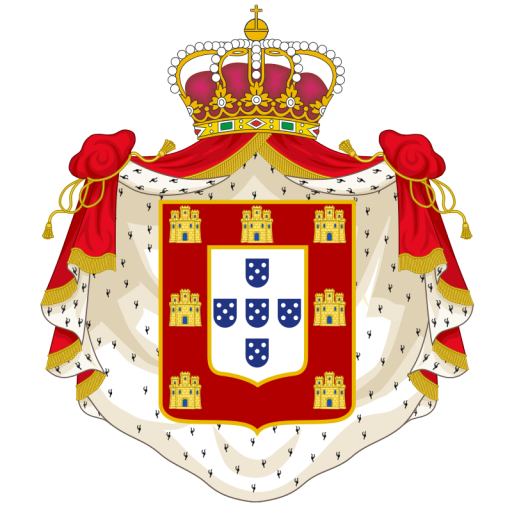
The House of Bragança traces its origins back to the 1st Duke of Bragança, Lord Dom Afonso, who was the illegitimate son of King João I of Portugal. Lord Dom Afonso married Lady Dona Brites Pereira, daughter and heir of the commander-in-chief of the armed forces of the Kingdom, Dom Nuno Álvares Pereira.
It was only from the 4th Duke of Bragança, Most Serene Lord Dom Jaime, that this great House gained rights to the succession to the Throne of Portugal. These rights were acquired because the mother of the 4th Duke was Her Highness Dona Isabel, sister of King Manuel I. She was also the daughter of Infante Fernando, Duke of Viseu, and therefore the granddaughter of King Duarte.
After the tragic death of King Sebastian in the fateful Battle of Alcácer-Quibir, his uncle, Cardinal-King Henry, succeeded to the throne for a short reign. After the death of the Cardinal-King, Portugal came under Spanish rule through Philip II of Spain, son of Infanta Isabel of Portugal, daughter of Manuel I.
At the time these events took place, succession law was controversial. There was a tradition and a desire, supported by national sentiment, that no king who was not Portuguese should succeed to the throne. In this context, Duchess Catherine of Braganza was the Portuguese relative of the last king of Portugal who could best embody national aspirations and rival Philip II in the succession to the crown. Despite this, Philip II would ultimately be acclaimed by military force. This new dynasty would last for three generations of Philips (I, II, and III).
On December 1, 1640, the Restoration of Portuguese Independence took place, carried out by a group of nobles and aristocrats who were fed up with Spanish rule. Thus, the Duke of Bragança was acclaimed King of Portugal, and this was legitimized by the Cortes(Parliament) in 1641. These Cortes approved the laws that had previously been known as the “Laws of the Cortes of Lamego.” These laws dealt with matters relating to the laws of succession, which were thus protected, and recognized the House of Bragança as the legitimate dynasty from then on. This set of laws would come to be recognized as the Fundamental Laws of the Kingdom.
Subsequently, in 1826, the Constitutional Charter maintained the same line of guidance and tradition “according to the regular order of primogeniture and representation, always preferring the previous line to the subsequent ones; in the same line, the degree closest to the most remote; in the same degree, the male sex to the female, in the same sex, the oldest person to the youngest” (art. 87), with the exclusion of foreigners, bastards (even if legitimized), and princesses married to foreigners and their descendants. In order for Princesses to maintain their rights to the Crown, in accordance with the legislation in force at the time, they were obliged to marry a Portuguese citizen, for which the indispensable Royal authorization was required (Chapter IV, Articles 86 to 90 of the Constitutional Charter of the Portuguese Monarchy of April 29, 1826). Thus, the line of succession follows the legitimate path, in accordance with the principles of primogeniture and representation. In the case of a female line, the Crown Princess is required to marry a Portuguese man, subject to prior royal authorization. This excludes any and all claims by foreigners to the Throne of Portugal. It was also mandatory, under the laws in force since 1641, the Fundamental Laws of the Kingdom, that princesses marry a nobleman, who also had to be Portuguese.
Three of the sons of King João VI (1767-1826) formed the branches of the Serene House and Dynasty of Bragança, namely the branch of Pedro IV (Liberal/Constitutional), the Branch of Miguel de Bragança (Miguelist / Absolutist) and the Branch of Infanta Ana de Jesus Maria (Constitutional).
The branch of D. Pedro IV is divided into two lines: the Reigning Line in Portugal of the Portuguese descendants of Queen D. Maria II, which will become extinct in 1932 with the death of the last King of Portugal, D. Manuel II (without descendants); and the line of the Imperial House of Brazil, which, being foreign, has no right to the Throne of Portugal.
The branch of the former Infante D. Miguel lost all rights of succession to the Crown. The former Infante D. Miguel. By Decree of March 17, 1834, he was stripped of his title and honors as Infante, and was ultimately banished and outlawed by the Law of December 11 of the same year, passed by the Cortes (Parliament) and signed by Queen Maria II (on December 19, 1834), which declared in its article 1: “The former Infante Miguel, and his descendants, are forever excluded from succeeding to the Crown of the Kingdoms of Portugal, Algarves, and their Domains” (Published in the Government Gazette, No. 152, of December 24, 1834), including being barred from entering Portuguese territory under penalty of death. In addition to losing all his dynastic and noble rights, which were taken away from him, he also loses his Portuguese nationality (according to Title II, Article 8, Constitutional Charter of the Portuguese Monarchy (decreed and issued by the King of Portugal and Algarves, D. Pedro IV, on April 29, 1826), Coimbra, University Press, 1875, p. 5).
Thus, in Portugal, after the Portuguese descendants of Queen Maria II, only the branch of Infanta Ana de Jesus Maria (with extensive Portuguese descendants in the House of the Dukes of Loulé) will retain dynastic rights to the succession to the Crown. Following the death of King Manuel II (on July 2, 1932), Her Most Serene Dona Constança (1889-1965), Duchess of Loulé and Countess of Vale de Reis, became “de jure” the sole heir and successor to the Crown with dynastic legitimacy to the throne of the Kings of Portugal and the legitimate representative of the Most Serene House of Bragança (European Royal Houses – Portugal, Flash! Collection, Soc. Tip., Lisbon, 2004, pp. 11 and 38).
The dynastic rights to the Crown of Portugal
With the death of King Manuel II, who had no descendants, and in accordance with the Constitutional Charter of the Monarchy, the line of succession passed to the collateral line. Thus, one must go back to His Majesty King João VI to find, according to the law, the closest collateral branch with rights to the Crown. The line of Pedro IV ended with the death of King Manuel II (the other descendants of Pedro are Brazilian and German, and are therefore automatically excluded because they are foreigners). The descendants of the branch of the former Infante Miguel, under the Law of Banishment and Proscription of 1834 (and also because they are foreigners), lost all their possible rights to succession to the Crown of Portugal. This is the line from which “Miguelist” pretender Duarte of Braganza descends, who got married to Isabel de Herédia (descendant of one of the main perpetrators of the regicide of portuguese King Carlos I and Prince Luís Filipe in 1908).
With the exception of H.R.H. Infanta Dona Ana de Jesus Maria (1806-1857), married to the Duke of Loulé (with extensive portuguese descent), the other Infantas, daughters of D. João VI, and sisters of D. Pedro IV and D. Miguel, either had no children or their descendants are also foreign.
Thus, the only branch with dynastic legitimacy upon the death of D. Manuel II (on July 2, 1932), which was in Portugal and without any impediment, quite the contrary, complying with all the necessary requirements under the Laws of Succession to the Crown and other legislation in force until the end of the Monarchy, is the dynastic branch of the House of the Dukes of Loulé.
The essential conditions for the marriage of the Princess or “Infantas” were that it be preceded by permission from those exercising parental and royal authority, which in this particular case, in relation to Infanta D. Ana de Jesus Maria in 1827, were exercised respectively by Queen D. Carlota Joaquina and Infanta Regente D. Isabel Maria.
In order for the Princesses (or Infantas) to succeed to the Crown of the Kingdom of Portugal, according to the Constitutional Charter, they had to marry a Portuguese man, in accordance with an ancient tradition long enshrined in the Fundamental Laws (Manifesto of the Rights of Her Most Faithful Majesty Dona Maria II and Exposition of the Portuguese Question, p. 26).
Unlike what happened in some European monarchies (where morganatic marriage existed), in Portugal the marriage of royalty, for the purpose of preserving all their rights to the Crown intact, was not limited to marriages with equals (Francisco de Vasconcelos, A Infanta D. Ana de Jesus Maria – Infanta de Portugal – Marquesa de Loulé, Lisbon, Instituto D. João VI, 2006, pp. 17 and 18).
Despite being a marriage between a member of the royal family and a nobleman, contrary to what some authors have written, under Portuguese law at the time, it was a fully valid and recognized marriage, and therefore did not limit the receipt or transfer of any rights or property, nor was it accompanied by any renunciation of his dynastic rights to the Crown of Portugal
It is known from documentation that the marriage of Infanta D. Ana de Jesus Maria to the Marquis of Loulé was recognized by the Crown and authorized by the then Regent of the Kingdom – Infanta D. Isabel Maria, with the concurrence of the Ordinance of the Cardinal Patriarch of Lisbon, D. Fr. Patrício da Silva, in order to grant the necessary ecclesiastical licenses, as attested to by the charter of Queen Carlota Joaquina addressed to the Cardinal Patriarch, granting permission for the marriage of her daughter, Infanta D. Ana de Jesus Maria to the 2nd Marquis of Loulé, together with the Ordinance issued by the Cardinal Patriarch, referring to the consent given by the Infanta Regent D. Isabel Maria.
Therefore, there is no doubt that the dynastic legitimacy to the succession to the Crown and the representation of the constitutional line of the Royal House of Portugal and the Most Serene House of Bragança fall upon the representatives of Her Royal Highness the Most Serene Infanta Dona Ana de Jesus Maria – The Most Serene Dukes of Loulé.
The Constitutional Dynastic Line of the Royal House of Portugal
Her Royal Highness Dona Ana de Jesus Maria de Bragança e Bourbon (1806–1857), Infanta of Portugal, was the youngest daughter of His Majesty King Dom João VI and Queen Dona Carlota Joaquina de Bourbon. The Infanta of Portugal, Dona Ana de Jesus, married D. Nuno de Mendóça, 2nd Marquis of Loulé (future 1st Duke of Loulé), 9th Count of Vale de Reis, Peer of the Realm, Master of the Horse of the Royal Household (2nd position in the Palace hierarchy), etc., in 1827.
The Marquis of Loulé was descended on both sides from the Portuguese Royal House, namely through his grandparents, the 3rd Duke of Cadaval and the 5th Marquis of Marialva, and at the time of his marriage (in 1827) he was 18th in line to the throne. The marriage between the Infanta Dona Ana de Jesus Maria and D. Nuno de Mendóça was conducted in accordance with the provisions of the Old Laws of the Kingdom and the Constitutional Charter regarding the marriages of princesses. Thus, the marriage was celebrated with the proper royal authorization (given by the Infanta Regent Dona Isabal Maria and Queen Dona Carlota Joaquina) and with a Portuguese nobleman. In this way, the Infanta continued to preserve all the rights to which she was entitled by birth in the Succession to the Throne of Portugal, thus ensuring the transmission to her descendants of all those same dynastic rights to the Portuguese Crown.
H.R.H. Dona Ana de Jesus Maria de Bragança e Bourbon, Infanta of Portugal, Marchioness of Loulé, Countess of Valle de Reis, Countess of Barcelos, Grand Cross of the Order of Our Lady of the Conception of Vila Viçosa, Dame of the Order of Saint Isabel and of the Order of the Noble Ladies of Maria Luisa (Spain). The Infanta was born on December 23, 1806, at the Royal Palace of Mafra. She was baptized on January 18, 1807, in the same palace where she was born. She died in Rome on June 22, 1857. On December 5, 1827, she married Lord Dom Nuno José Severo de Mendóça Rolim de Moura Barreto (1804–1875), 1st Duke of Loulé (November 30, 1862), 2nd Marquis of Loulé, 9th Count of Vale de Reis, 24th Lord of Azambuja (year 1200), etc. He was the son of the first Marquesses of Loulé (1799) and Counts of Vale de Reis (1628). Through this marriage, and in compliance with the legal provisions for the marriages of princesses, the House of Loulé became part of the immediate line of succession to the Throne of Portugal. From this marriage there had in addition to three daughters had two sons, being the heir: Lord Dom Pedro, 2nd Duke of Loulé, who follows.
Lord Dom Pedro José Agostinho de Mendóça (of Bragança and Bourbon) Rolim de Moura Barreto (1830–1909), 2nd Duke of Loulé, 3rd Marquis of Loulé, 10th Count of Valle de Reis, Master of the Horse to Kings Dom Luís I, Dom Carlos I, and Dom Manuel II, etc. He married Lady Dona Constança de Figueiredo Cabral da Câmara (daughter of the 2nd Counts of Belmonte). They had two daughters from this marriage: Lady Dona Maria Domingas de Mendóça Rolim de Moura Barreto (1853-1928), 3rd. Duchess of Loulé, who died unmarried, and Lady Dona Ana de Jesus Maria de Mendóça Rolim de Moura Barreto (1854–1922) married her cousin, D. João da Câmara Berquó, a “Fidalgo” in the Royal Household, son of D. João Bernardo Viana Berquó (Son of Marquis of Cantagalo) and Lady Dona Jerónima de Figueiredo Cabral da Câmara (daughter of 2nd Counts of Belmonte). This marriage produced a single daughter: Most Serene Lady Dona Constança de Mendóça, who follows.
H.R.H. Dona Constança (1889–1965), Crown Princess “de Jure” and Head of the Constitutional Dynastic Line (after the death of King Manuel II on July 2, 1932), 4th Duchess of Loulé (Juro e Herdade), 5th Marchioness of Loulé, 12th Countess of Vale de Reis, etc. She married D. José Pedro de Basto Feyo Folque, Count of Vale de Reis (authorization given by King Manuel II), who fought in the monarchist incursions against Republic (1911/1912) and in the Restoration of Monarchy in Monsanto (1919). He was also a member of the Political Council of His Majesty King Manuel II, etc. He was the son of the Viscounts of Fontainhas. From this marriage there had in addition to three daughters had two sons, being the heir: Most Serene Lord Dom Alberto, 5th Duke of Loulé, who follows.
H.R.H. Dom Alberto (1923-2003), Prince of Beira “de Jure” (after the death of King Manuel II on July 2, 1932) and Head of the Constitutional Dynastic Line of the Portuguese Royal House, 5th Duke of Loulé (Juro e Herdade), 6th Marquis of Loulé, 13th Count of Vale de Reis, representative of the Dukes of Terceira and the Counts of Rio Grande, representative of the Lordship of Azambuja, the Lordship of Póvoa e Meadas, the Morgado da Quarteira, Head of the Name and Arms of the Portuguese Mendóça, the Rolins (Azambuja), the Moura and the Barretos, etc. He was born in the Royal Palace Quinta da Praia in Belém, on July 10, 1923. He died on September 24, 2003. He married on July 8, 1953, Lady Dona Maria Augusta Amélia de Moraes Cardoso Menezes, Duchess and Marchioness of Loulé, Dame Grand Cross of the Orders of Santa Isabel and the Military Order of Saint Sebastian, known as the Order of the Arrow. Her Royal Highness D. Augusta was born on January 10, 1932, in Lisbon, and died in Cascais on May 5, 2024, daughter of Lord D. Henrique de Mello Breyner Cardoso de Menezes (Grandson of the Counts of Margaride and Sobral) and Lady D. Helena de Carvalho Pereira de Moraes (Granddaughter of the Viscounts of Moraes). They had in addition to five daughters had three sons, respectively: H.R.H. Dom Pedro (b. 1958), 6th Duke of Loulé, etc., married to D. Margarida Vaz Pinto (divorced), with one son and one daughter; His Highness Dom Henrique (b. 1964), married to his cousin D. Teresa Cardoso de Menezes, with one daughter; and His Highness Dom Filipe Alberto Folque de Bragança e Bourbon de Mendóça (b. 1967), Count of Rio Grande, Grand-Master and Governor of the Military Order of Saint Sebastian, known as the Order of the Arrow, Knight of Honor and Devotion of the Sovereign Order of Malta, etc. (sua alteza-domfilipe).
 Casa Real De Portugal