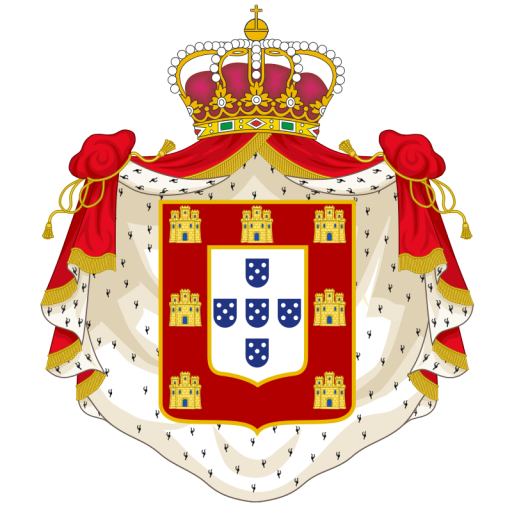
ABOUT HISTORY
HOUSE OF BURGUNDY (also Afonsine Dinasty)
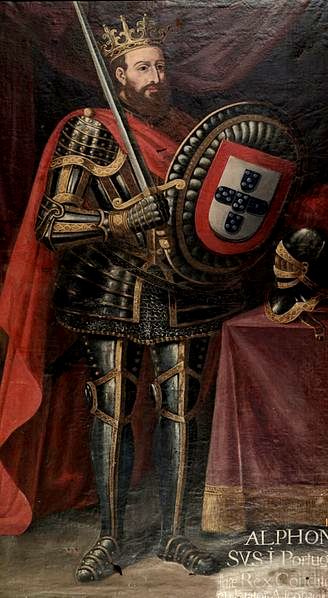
After the wars for independence, which end with the signing of the Peace Treaty, in Zamora (1143), carried out between D. Afonso I of Portugal and D. Afonso VII de Leão, the King of Léon recognizes to D. Afonso Henriques the title of Rei.
D. Afonso Henriques will continue to regain the territory that was in the hands of the Moors, beginning a period of advance to the south. Thus, there are the Conqueer of Leiria (1145), Taking of Santarém and Conqueer of Lisbon (1147), Taking of Alcácer do Sal (1158), Beja (1162), Conqueer of Évora (1165), Taking of Serpa , Moura and Juromenha (1166).
In 1179, through the Bula Manifestatis Probatum, Pope Alexander III recognizes to D. Afonso the title of King.
With the Foundation of the Kingdom of Portugal, begins the First Dynasty, called Burgundy, or Afonsina. D. Afonso’s son, King D. Sancho I, will continue to regain the territory from the Moors, being continued in this work by his son King D. Afonso II, and by his sons Kings D. Sancho II and D. Afonso III..
In the year 1249, D. Afonso III will conclude the Conquest of the Algarve with the taking of Faro, Albufeira, Loulé and Aljezur. Also in this reign will be celebrated the Treaty of Badajoz (1267), by which the King of Castile recognizes Portugal the right to possession of the Algarve.
D. Afonso III was succeeded by King D. Dinis (1279-1325), who founded the University. In his Reign the Treaty of Alcanizes (1297) will be celebrated, by which the Portuguese borders are definitively fixed. It is also worth mentioning the creation of the Order of Christ (1319), which replaces in Portugal the Order of the Templars that was extinguished by the Pope. From his marriage to Princess D. Isabel de Aragão (Queen Santa Isabel), his heir son D. Afonso IV was born, in whose reign the victory in the battle of Salado (1340) takes place, where the Kings of Portugal and Castile fought together against the Moors.
D. Afonso IV succeeds his son D. Pedro I, who will reign for ten years, establishing justice in the Kingdom, more solidly and widely. His successor will be King D. Fernando I, the last Sovereign of the first dynasty.
HOUSE OF AVIZ (also Joanine Dinasty)

Dona Beatriz, daughter of Dom Fernando, wife of the King of Castile João I, was entitled to the Throne of Portugal, but the Nation manifested itself against the coming of a Queen who was married to a foreign king. In this way, there were a revolution headed by the Master of the Order of Avis, D. João, bastard son of El-Rei D. Pedro I, who was proclaimed by the people of Lisbon as “Defensor e Regedor do Reino” (defender and governor of the Kingdom), being acclaimed King in the Courts of Coimbra, on April 6, 1385. That same year, with the glorius victory over the Castilians in the battle of Aljubarrota, thanks to the military genius of D. Nuno Álvares Pereira (Saint Constable), National Independence was consolidated.
Thus was born the Second Dynasty called Avis, the great Dynasty, which will be responsible for the discoveries, expansion and formation of the Portuguese Overseas Empire. From the marriage of King Dom João I, with Dona Philippa of Lancaster (in 1387), daughter of the Duke of Lancaster (John of Gaunt), and granddaughter of the King of England, the most extraordinary generation of Princes was born – The Ingenious Generation: Dom Duarte (future King), Dom Henrique, Dom Pedro, Dom João and Dom Fernando (the “Holy Prince”).
As stated, in the Reign of Dom João I (+1433), the Epic of Discoveries begins, first with the conquest of Ceuta (1415), the strongest Moorish Square in North Africa, where Dom João I, arms his sons Knights. Than it follows the expeditions sent by IPrince Dom Henrique, through which the discoveries of the Islands of Porto Santo (1419) and Madeira (1420) take place, continuing in the Reign of Dom Duarte, with the great adventure of the passage of the feared Cape Bojador (1434 ). From then on, Portugal started to give new worlds to the world.
During the reigns of Dom Duarte (+1438) and Dom Afonso V (+1481), Infante Dom Henrique (+1460), who had received the sense of consecration to a higher mission, continues to undertake to bring faith in the Cross of Christ to new people, who lived in the darkness of barbarism. In the year 1437, the Tangier disaster occurred, where Prince Dom Fernando (Holy Prince) will be imprisoned.. In 1453, the discovery of the Azores Archipelago was concluded; and in 1460, exploration of the Cape Verde Archipelago begins.
After the death of Infante Dom Henrique, the Kings of Portugal call on them the civilizing mission. Still in the reign of Dom Afonso V, the islands of São Tomé and Príncipe (1470) were discovered, and the Conquest of Arzila (1471) took place. Dom Afonso V “The African”, was a King like the Kings of the first Dynasty, made of bravery against the infidels in their own territory, where they remained a threat. Then the Alcácer Ceguer, Arzila, Tangier squares fall, and the King changes his name to “King of Portugal and of the Algarves from here and beyond in Africa …”.
Dom João II (+1495), one of the greatest figures in Universal History, for the decisive impulse he gave to the Discoveries, opening up the ways of the World to Europe. Its continued action pushed Portuguese ships southwards, along the African coast. In 1482, Diogo Cão reaches the mouth of Zaire and explores the Congo region, implementing the first Portuguese Padrão (stone pillar left by Portuguese maritime explorers in the 15th- and 16th-centuries to record significant landfalls and thereby establish primacy and possession). In 1487, Dom João II, sent Pero da Covilhã and Afonso de Paiva by land, in demand from the Kingdom of Prester John and India. In the following year Bartolomeu Dias, doubled the Cabo das Tormentas (Cape of storms) that now was to be called Cape of Good Hope. Thus the name of the great King John rises, who prepared everything, directed everything in an admirable vision, only matched by the Infante de Sagres (Prince Henry). The end of his reign is crowned with the signing of the Treaty of Tordesillas (1494), which divided the world to be discovered by Portugal and Castile.
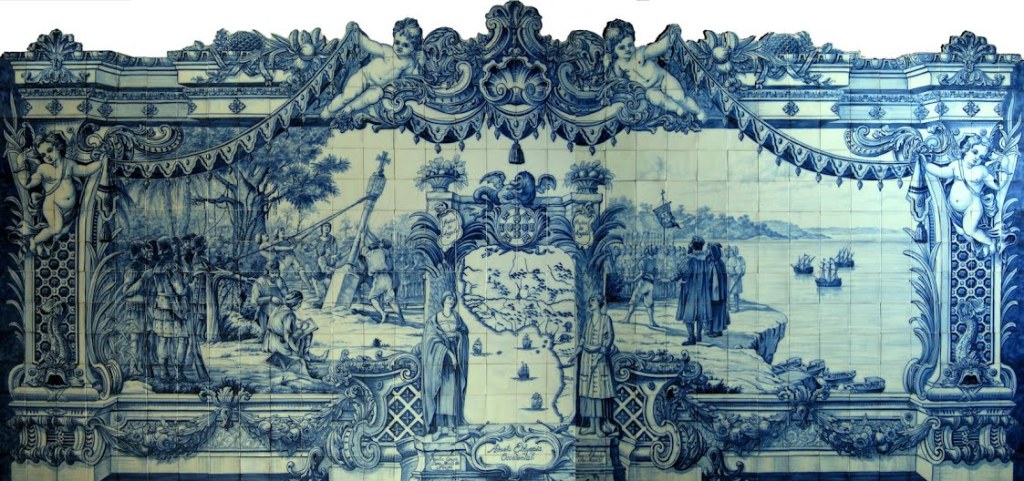
Dom João II dies without leaving legitimate descendants, succeeding him then the son of Prince Dom Fernando – Dom Manuel I (+1521). During his reign, Vasco da Gama arrived in India by sea (1498) and Pedro Álvares Cabral discovered Brazil (1500). Portugal’s effective presence in the Indian Ocean begins. Afonso de Albuquerque conquers Ormuz (1507) and Goa (1510), followed by the conquest of Malacca (1511).
Dom Manuel I’s reign was to mark Portugal’s presence in the East, exercising peaceful relations with those who treated us like this – India, Thailand, China, Japan; starting a time of cultural exchange that lasts until today. The splendid Embassy that Dom Manuel I sends to the Pope (1514) is a testament to this.
With King Dom João III (1557), Portugal reached its peak in the East, establishing commercial warehouses in China (1517) and Japan (1543), spreading its missions throughout Oceania. Dio’s second defense (1546), will mark our presence for more than four hundred years. It’s in this reign that the Emperor of China gives Macau over to Portugal (1557), as a reward for our action against the Chinese sea pirates.This reign will also mark the beginning of the systematic colonization of Brazil (1530), but on the other hand, the Portuguese decline in North Africa, with the abandonment of various possessions in the Maghreb Coast. With King Dom Sebastião (+1578), the disaster of Alcácer Quibir (1578) occurs, where the young King imbued with the ideals of Cavalry, in the ardor for the service of God in the defense of Christianity, launches on the expedition to Morocco, where the portuguese army were destroyed. With the end of this reign and the ephemeral reign of his uncle, Cardinal Dom Henrique (+1580), the second dynasty ended, and the throne would pass to a foreign dynasty.
HOUSE OF HABSBURG (AUSTRIA, also Philippine Dinasty)

The succession to Cardinal Dom Henrique, would be claimed by several descendants of King Dom Manuel I – the foreigners Filipe II of Spain, the Duke of Savoy, the Duke of Parma, and the Portuguese – Duchess of Braganza, and the bastard Dom António, grandson (Prior of Crato). The final outcome is given by the army of Philip II, who will later be acclaimed and sworn King of Portugal in the Cortes de Tomar (1581), committing the King to keep the Laws of the Kingdom, the uses, customs and privileges of the Portuguese.
In the three Philippine Kingdoms, of D. Filipe I (II) (+ 1598), D. Filipe II (III) (+ 1621) and D. Filipe III (IV) (+ 1665), the Portuguese Overseas Empire was subjected to vortex and conquest of the enemies of Austrias, such as the French, Dutch, and English. The guarantees given that Portugal would not lose its Independence, due to the dualist Monarchy that was created, being the same King to govern two different Kingdoms, faded, trying to reduce Portugal to a mere Province of Spain.
HOUSE OF BRAGANZA (also Brigantine Dinasty)

On December 1, 1640, the Revolution took place by the hand of a group of noblemen, who quickly triumphed by restoring National Independence, and the Duke of Bragança – Dom João IV – was acclaimed as King of Portugal. Heroic moment that would found the Fourth Dynasty in the Most Serene House of Braganza.
Dom João IV’s action (+1656) was tireless; it was necessary to remake the army, build fortresses for the defense of the Kingdom, and the Restoration of our Overseas Empire. Salvador Corrêa de Sá, reconquered Angola (1648), and the General Francisco Barreto (who for his achievements will have the mercy of the Title of Count of Rio Grande), defeated the Dutch in the Battle of Guararapes (1648), expelling them definitively from Recife, Brazil in 1654. The Embassies that the King sent to the European powers, were decisive for the recognition of the Independence of Portugal, and of the new Dynasty.
His son Dom Afonso VI, will continue the work of his Father, in the defense of the Kingdom against the Spaniards. He succeeds with the help of valiant nobles, such as the Marquis of Marialva and the Count of Vila Flôr, victorious in the battles of the Linhas of Elvas (1659), and the Ameixial (1663). His reign will be marked by the influence of the Count of Castelo-Melhor.
His brother Dom Pedro II (+1706), will sign the Peace Treaty with Spain (1668), continuing the restoration of Portuguese Empire. During his reign, gold mines in Brazil (1698) will be discovered and explored. During the war of succession in Spain (1700-1706), Portugal will be an ally of Archduke of Austria, against Philippe of Anjou. In this theater of war, the intrepid Portuguesearmy commanded by the Marquis of Minas, invades Spain and enters Madrid triumphantly (1704), acclaiming Archduke Charles.
The reign of his son, King Dom João V (+1750), remains in History due to the grandeur and splendor of his Court, making his name and that of Portugal, respected throughout the world. There is the battle of Matapão against the Turks, where the King sends a squadron commanded by Lopo Furtado de Mendóça, Count of Rio Grande, who will win them along with the ships of the Order of Malta, the Pontifical States and Venice. He obtains the greatest privileges of the Holy See, for the Church of Lisbon, as the Patriarchal dignity (1716). The Pope grants him the title of King “Most Faithful” (1748). Dom João V, founds the Royal Academy of History (1720), and starts a time of great public works, such as the Aqueduto das Águas Livres (Aqueduct of the Free Waters), the Convent of Mafra, and many others spread across the country.
King Dom José I (+1777), will have his reign remembered by the Lisbon Earthquake (1755), and by the Absolutism exercised by the Marquis of Pombal, his minister, who will impose a regime of terror and fear. The execution of the Marqueses de Távora is one of the most striking episodes of the cruelty of those times.
“The Pious” Queen Dona Maria I (+1816) will succeed him, who will be an example of rectitude for all, with the first measure to free all political prisoners of the Pombal era, and to moralize public life, suppressing unnecessary expenses, proceeding to severe savings in the Royal Palaces. She increased Industry and Trade, improving the conditions of the Navy and the Army. The Queen reinstated royal hearings on Tuesdays and Thursdays, with everyone admitted there. She was a Queen adored by all of the population.
His successor was King Dom João VI (1767-1826), who, due to his mother’s illness, was Regent of the Kingdom, during a period (1799-1816). His reign will be marked by French invasions and European instability. With the vision of a true statesman, he decides to put into practice the plan for the transfer of the Royal Court to Brazil (1807), thus safeguarding the Independence of Portugal, threatened by Napoleon. In this overseas state, he carries out a remarkable work of progress and economic development. In 1815, he promoted Brazil to a Kingdom.. In 1821, he returned to Portugal, leaving his son Dom Pedro in Brazil, who a year later would give Independence to that State. In this difficult period of his reign, where liberal desires and absolutist forces were taking over the national life more and more, the King was always the guardian of prudence and serenity. The last years of his life were spent in the midst of palace intrigues and conspiracies. The murder of his loyal valiant – the 1st Marquis of Loulé (1824) and the attempted revolt “Abrilada” (1824), orchestrated by the Prince (Infante) Dom Miguel and the Queen, were the most significant events of the end of his Reign.
It followed the Regency of Princess Dona Isabel Maria (1826-1828), the ephemeral Reign of the usurper Dom Miguel I (1828-1834), the Regency of Dom Pedro IV, on behalf of Queen Dona Maria II, and the Civil War (1832- 34), from which the liberal cause wins.
During the Reign of Dona Maria II (1826-1853), there were disagreements between the various political currents, giving rise to a certain feeling of disorder and institutional instability, which leads to the dictatorship of Costa Cabral, generating the Revolution of Maria da Fonte (1846). This was followed by a series of governments, sometimes led by one current and another, with figures such as the Duke of Saldanha and the Marquis of Sá da Bandeira in front of them. With the Queen’s death in 1853, her husband King Dom Fernando II took over the Regency until 1855. Since his arrival in Portugal, Dom Fernando has been concerned with safeguarding the artistic heritage of Portugal, undertaking at his expense restoration in several monuments, as in Batalha Monastery and in Belém Tower.
The reigns of their children Kings Dom Pedro V (1855-61) and Dom Luís I (1862-89), were years of material and scientific prosperity, thanks to the exceptional intelligence and preparation of the children of Dona Maria II, making Portugal recover its place in the concert of Nations, alongside the technological and social progress of Europe’s main powers. The death of Dom Pedro V, with typhoid fever (which he had been beaten on his multiple visits to hospitals, where he was going to comfort the sick with this plague), causes the greatest public consternation, being idolized by the people for the kindness of his heart.
King Dom Carlos I (1863-1908), son of King Dom Luís I, begins his reign by confronting England’s “Ultimatum” around Portuguese possessions in Africa – the pink map. Portugal will eventually give in, due to the threat of war. The Africa Campaigns, the victories of Marracuene, Magul, Chaimite, etc., continued by the military like Mouzinho de Albuquerque, Caldas Xavier and Paiva Couceiro. Dom Carlos’ extraordinary international action earned Portugal a European prestige difficult to match. At that time, Lisbon received the visits of King Edward VII of England, Kaiser Guilherme II of Germany, King Afonso XIII of Spain and the President of the French Republic Loubet. On February 1, 1908, King Dom Carlos I and Prince Royal Dom Luís Filipe were savagely murdered, causing a wave of astonishment and indignation across Europe
Dom Manuel II (1889-1932), succeeded to his Father, the King Dom Carlos I, and inherited a Kingdom shaken by the last events, like an institutional and political crisis, favorable to the Republican propaganda, which Dom Manuel tried to contain through a political of “calming”. A military coup from the subordinate posts of the Navy and the Army, supported by secret societies, would proclaim the republic on October 5, 1910. On the same day, the Royal Family left Portugal for exile.

 Casa Real De Portugal